
EDU
Transforming Pits, Places and Public Health
EDU: “Effluent Diversion Unit”
It is a fitting for standard pipes. It separates liquid from fresh feces. Our animation depicts the steps of separation.
Pit latrines: Wastes hidden from sight ≠ safely managed
As many WASH practitioners would know, pit latrines are the most commonly used toilet systems. Every 1 in 4 people in the worlds uses a pit latrine everyday. Yet “pit latrines are not pit latrines”- as Dr Strande famously wrote in her review article. Simply put, pit latrines are almost always made to be a poor containment system, letting blackwater seep though the system and contaminate the surroundings.
And practically speaking, pits can fill up really quickly, especially in flush or pour-flush toilets (which is increasing more aspired for, than flushless direct pits), densely populated environment (like camps for displaced people where toilet facility is highly limited), rainy places, and pits that are connected to greywater/ drainage pipes.
The EDU is suitable for a range different settings. Check out our matrix.
Let's consider some basic numbers
When we consider a toilet in a single-storey shelter that’s connected to an offset containment system, namely an offset pit, rather than a direct pit — yes, people do see the benefits of a more sturdy toilet slab and much lower risk of collapse, and the odor would also be much less unbearable — they are essentially also flushing down water that occupies volume, which means much higher emptying frequency. This is a big disadvantage.
Let’s do some quick Math. Here are some conservative assumption*:
Each person every day
flushes down
1L** water down the toilet,
0.5L cleansing water (yes we are assuming the person is a “washer”),
produces
1L urines, and
0.15kg feces
That makes feces account for about 6% of the total volume. The larger the volume of liquids like flush water and cleansing water that go into the toilet pit, the lower the percentage would be. ***
Think about that. Isn’t that mad to mix in 6% of pathogenic feces into the 94% rest of the cleaner content — which is essentially water and urine, and is relatively clean — and then end up having 100% pathogenic content that has to be processed for safe discharge/reuse? Needless to say, water is heavy to transport — if you’re using a desludging truck! (Check out the 5 typical steps of fecal sludge management FSM)
*The actual numbers can vary quite a lot by demographics and geography.
**Many flush toilets are using up to 6L of water per flush.
***We have a calculator developed for operators and WASH practitioners alike to make some more detailed estimations, calculating solid-liquid ratio, volume needed, filling time etc. based on various inputs.
EDU: Capturing the wisdom of solid-liquid separation
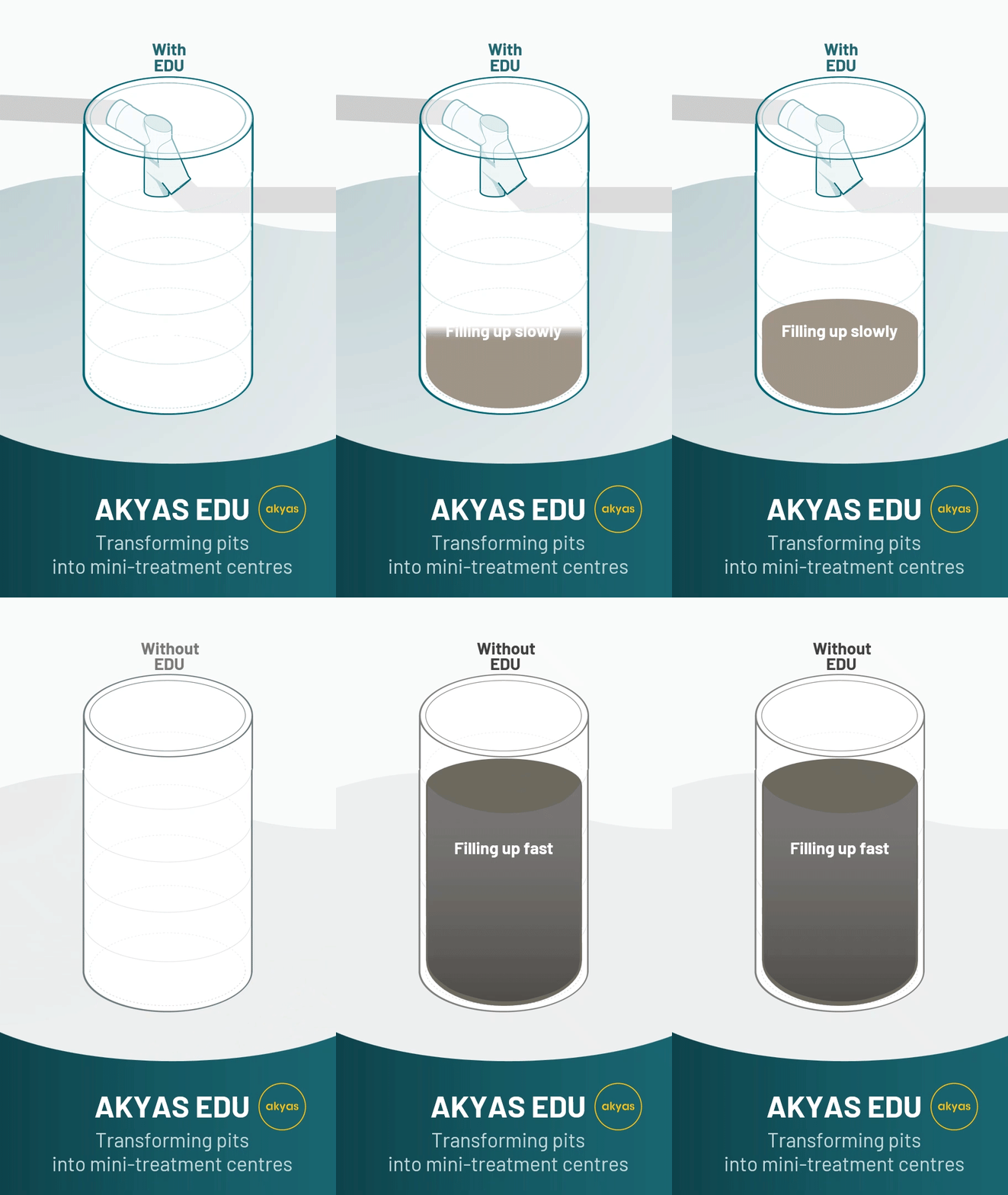
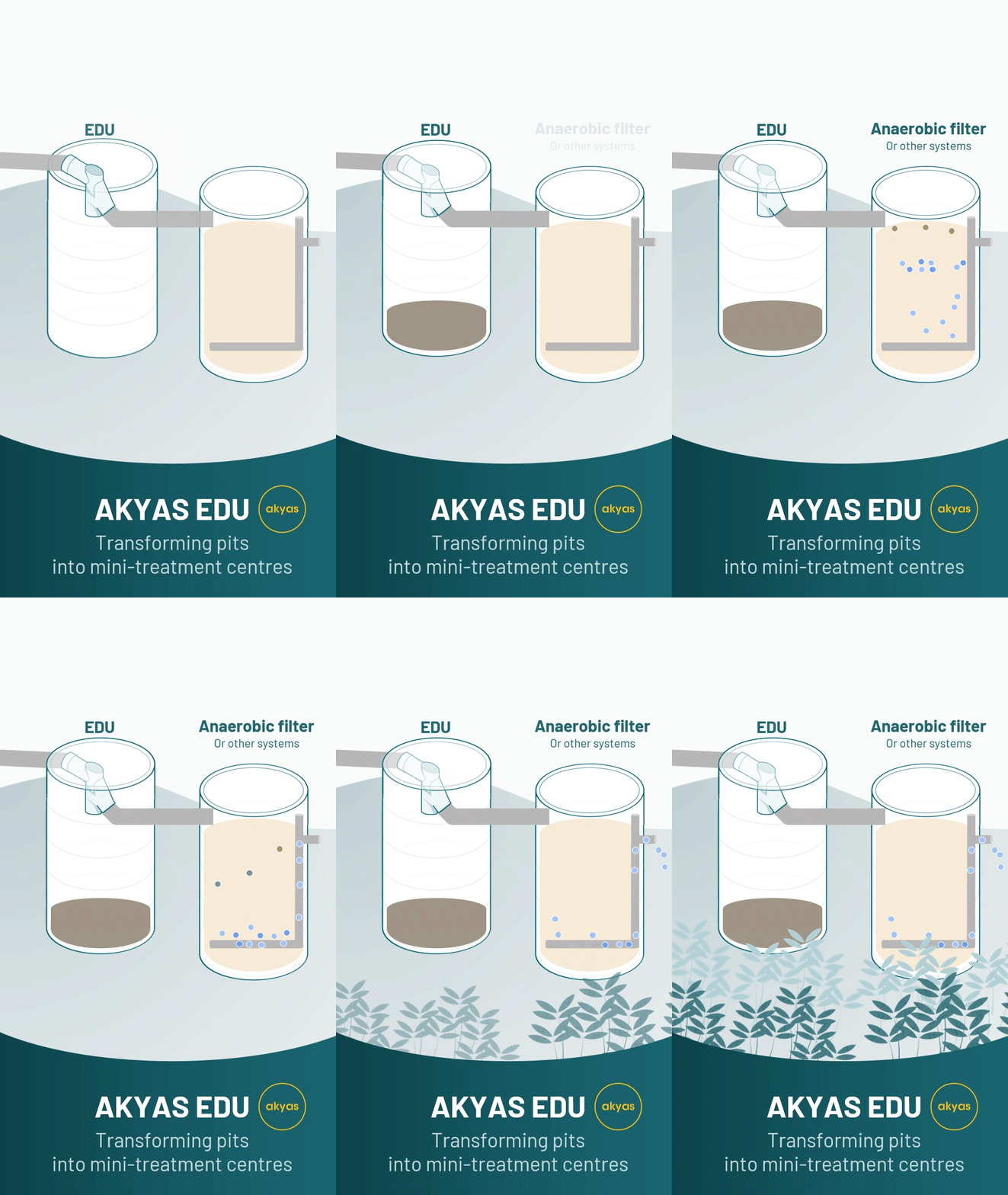
Crucially, the EDU is a back-end separator that reduces the filling rate of the fecal containment chamber (10X-20X filling time in optimal operation) while channeling the much cleaner liquid fraction to another chamber, or another system, for much easier and efficient subsequent treatment:
One example of liquid fraction treatment is an anaerobic filter with gravels and sand.
Check out EAWAG’s Compendium of Sanitation Systems and Technologies to see the range of options suitable for your context for both solid and liquid streams, and how to build them properly. You’ll notice the EDU is making things easier!
General FAQ
-
Yes — as in any kind of installation. We make it simple:
Standard 4-inch straight pipe with no elbows is recommended for entry pipe into the EDU. The distance between the toilet bowl/ toilet pan and the EDU — the shorter the merrier! You do want minimum breakdown of fresh feces before reaching the EDU. In most of our operations we keep it below 5m.
You always should have downstream treatment systems for the liquid and solid fractions. Check out EAWAG’s comprehensive Compendium of Sanitation Systems and Technologies.
-
No special flush methods.
Pour-flush toilets and a luxurious ceramic toilet — with or without water-efficient designs — are completely fine.
A flush of 1L in one-go (no hesitation*!) is sufficient.
If you’d like to go for higher volumes and strengths, that’s completely fine.
(*When a pour-flush toilet user hesitates with their flush and goes slow with their bucket of water, we doubt if they can really flush away their waste properly! So, flush with confidence.)
-
Yes absolutely. The EDU can divert both flushes and slower streams of liquids like cleansing water.
So, if you’re using a bidet of any form, that’s fine.
-
Run your toilet system (while installing the EDU) with water. If your angles are correct, you’ll see that over 95% of all liquids are captured. i.e. for every 1L you throw into the toilet pan, you should be collecting less than 50mL of water in the fecal chamber!
-
Technical:
An EDU is an enabler for safely managed sanitation.
An EDU separates liquid from solid. When flushing with 1L, the maximum amount of liquid captured can go as high as 0.95mL. All is done with a simple fitting without any use of electricity.
As fresh feces is separated at an early stage, the liquid fraction is much cleaner (lower in BOD, TS levels) and requires a much simpler, smaller and less costly approach for subsequent treatment. Also the amount of fecal solids are accumulated at a much lower rate. At optimal operation, the filling rate of the fecal containment (e.g. a pit) can be 10X-20X the original rate.
The EDU is an enabler for more efficient downstream treatment systems, thus more downscaled ones (and hence on-site treatment). It is compatible with a wide range of systems and technologies. For example, properly built anaerobic filter can have a higher treatment capacity while maintaining the same sizing — because the organic load in the filter exiting the EDU is much lower.
The EDU is also compatible with a wide range of front-end interface products like SATO pan, and even ceramic toilet bowls; intermediate connectors like SATO I-trap or typical S traps.
Social & behavioral
An EDU separates liquid from fresh feces in the backend without the user seeing (it is not a front-end interface that requires behavior change).
Reduced desludging frequency can mean less conflicts between community members, especially among communities where space is very cramped.
Supply chain:
The EDU is one addition to the existing products on a local market. For example, there are concrete pit rings producers selling to households. We are adding one product to their portfolio rather than replacing existing components. The EDU is easily understood to be a synergistic component to local businesses.
-
Condominium projects often face the problem of clogging. The EDU can achieve a good level of solid-liquid separation, diverting solids at the upstream end, and reducing clogging in the downstream pipe network.
If you have a condominium sewer project in planning, or conducting feasibility studies, reach out to us. We can share more!
Troubled by frequent desludging?
Purchase EDUs today
All purchases come with a complementary guidebook.
Featured questions
For WASH professionals & program managers
Q: I'm a WASH practitioner for development settings. What's the planning process that should go into integrating the EDU in my organisation's operation?
Integrating the EDU into your WASH programs is not about “adding a new technology” but more about upgrading conventional systems to better meet WHO, and UNICEF safely managed sanitation objectives, with less operational and social risk.
-
The EDU is always used with downstream treatment (e.g. anaerobic filter, constructed wetland, or other systems) to help achieve safely managed sanitation as defined under WHO and national WASH frameworks.
A simple entry point is an “upgraded” double‑pit system: one pit for fecal fraction and one for the liquid fraction (with an anaerobic filter or similar), sized for a household’s daily use.
Plan ahead and take action. Compare the different combinations (e.g. wetland, anaerobic filter etc for the liquid fraction) in relation to your context. Estimate the daily input and consider the end uses (/safe discharge) of the processed wastes. Then you can do some calculations on the capacity, sizing and space needed for your shortlisted downstream treatment systems and narrow down to the feasible and desirable ones. Refer to Eawag’s Compendium of Sanitation Systems and Technologies for treatment options.
Sketch a plan view and section of the proposed setup, and allow some height for the EDU’s installation within the existing containment structure.
-
Engage with the community you work with at an early stage. Evaluate needs and priorities in sanitation and water‑use practice while also raising awareness on the need for safely managed sanitation, and encourage them to envision the benefits of liquid-solid separation can bring to their desludging/ waste dumping practices, as well as environmental and public health.
Gather both baseline data of users needs, and midline data during operation to understand users satisfaction. But this is not for the sake of meeting KPIs, but rather, understand what corrective action should be taken and learnings documented.
-
Planning alone won’t get you anywhere. Try doing things. Get an EDU in your hand and play with it. Test build your first installation with imperfections - and learn from the process by building and consulting the people, and correcting what you have.
Q: I'm a program director/ manager of a non-profit and am considering integrating a market-based approach for sanitation. What do you say?
Market Based Sanitation (MBS)* approach is a powerful way to transition from project-based WASH programs to sustainable locally-embedded models. The EDU as an off-the-shelf device, is especially suited for this model.
-
AKYAS developed and implemented our MBS pilot using the EDU, with learnings already published. Our implementation partnerships with large and small organisations, including iDE, WaterAid, BRAC, and NGO Forum, and have deployed EDU in real‑world settings with excellent field observations and results, including households’ willingness to pay.
-
Our EDU is an off-the-shelf pipe fitting that can integrate seamlessly into a supply chain that’s already existing locally (e.g. pit ring producers, sand and gravel suppliers, pipe fittings distributors). There are no sophisticated parts (like mechanical hardwares) needed to build safely managed sanitation facilities with our EDU, hence the technical and social sustainability in the long term.
We do believe a truly pro-poor inclusive MBS approach requires subsidies in some ways, to enable equitable access to safely managed sanitation.
Check out our publication on our learnings.
*Bigger organisations like International Development Enterprises (iDE) and UNICEF have developed methodologies and been running MBS programs with funders' support. (Check out their publications).
Q: I’m a supply chain officer. How would you describe the comparative value of the EDU among WASH products, and how can it be practically incorporated into procurement mechanisms?
The EDU is essentially a versatile, value-adding plug-in for a range of existing sanitation facilities’ design ( (whether conventional or alternative). While T- or V-pipes are often procured as a spare component in cater field needs in all sanitation fieldwork, the EDU (also a plumbing fitting), is the more useful, enabling and smartly-engineered cousin of a T- or V-pipe. The EDU enables better sanitation compliance outcomes in case of field installations when used wisely.
-
The EDU is categorically a sanitation product. Sanitation is often an under‑prioritised field compared with water supply and hand hygiene, yet the EDU slots naturally into your existing sanitation‑system‑components category—alongside items such as toilet pans, prefabricated toilet shelters, and HDPE containment vessels—rather than as a wholly new “innovation” line.
Similar products: Urine-diversion dry toilets are often considered to be similarly achieving urine-diversion. However the EDU is suitable for wet toilets, which is used among “washers”. UDDTs often fail socially due to lack of social acceptance, or technically due to overly watery inputs.
The EDU requires no complex mechanical hardware or electricity, so local masons, plumbers, and fabricators can build and maintain it with minimal retraining.
The EDU is complementary to a range of front-end interface and backend downstream treatment systems. Rather than being a “competitor”, we are an enabler to unlock more suitable systems for various conexts.
-
With a small percentage of add-on cost to an entire sanitation system like septic tank and pit latrine, we can enable much better compliance with relevant standard (e.g. E. coli, protection of public health and removed disease risk in receiving water bodies, safe containment, prevention of human contact from excreta, etc)
If your organisation relies on a global warehouse where shipments are dispatched from headquarters to field locations, EDU can be included as an additional component alongside conventional items such as pans, slabs, prefab shelters etc, without disrupting existing logistics or categorisation.
Where pre‑qualification of suppliers exists in the procurement process, pilot testing should be encouraged rather than automatic screening‑out of innovations.
Products should be evaluated primarily on technical functionality and the outcomes they enable— for example, reduced BOD levels, slower fill‑rates, and lower desludging frequency— compared to other WASH products, not solely on the scale of organisation.
A great product without mass‑scale production capacity is a capital‑investment challenge rather than a complete “show-stopper”. We as an impact-driven SME, treat capacity expansion as a planned, time‑bound response to secured endorsements and purchase orders.
Q: Is the EDU suitable for the humanitarian WASH cluster and humanitarian setting in general?
The EDU is essentially a versatile, value-adding plug-in for a range of existing sanitation facilities’ design (conventional or not). While T- or V-pipes are often procured as a spare component to cater field needs in all sanitation fieldwork, the EDU (also a plumbing fitting), is the more useful, enabling and smartly-engineered cousin of a T- or V-pipe. The EDU enables better sanitation compliance outcomes in case of field installations when used wisely.
-
In emergencies, pit latrines are often the fastest way to contain fecal waste, but they fill up quickly under high use.
The EDU slows the fill‑up rate of fecal containment by 10–20 times, which:
Reduces desludging frequency and associated costs.
Lowers the risk of pits overflowing or being mismanaged.
Makes it easier to maintain coverage and service standards aligned with the Sphere Handbook & WHO over time.
This can be especially valuable in dense camps, urban emergencies, or highly frequented toilets, where space and logistics are severely constrained.
For transitioning from emergency response to more stabilized phase, the EDU can also complement the planning of better treatment systems and facilities, including increasing the capacity of the overall treatment facility while maintaining a more compact size. Essentially the EDU device can improve sanitation operation outcomes.
-
The EDU is a simple, gravity‑driven pipe fitting that can be integrated into pit‑based or other containment systems already used by WASH clusters
Because it
requires no electricity
uses widely available materials
can be installed by local masons or technicians,
it reduces the technical and capacity‑building risk often associated with deploying new products in humanitarian settings.
We tested the EDU in combination with various downstream systems. When used together with anaerobic sand filter, we recorded a 99% drop in BOD level and 98% drop in pathogen level - entry of mixed wastes into the EDU and effluent exit from the anaerobic filter. Significant drops in TS and BOD right after passing the EDU is also recorded. Result available in our publication.
-
AKYAS has produced visual guidance documents for EDU use in crisis‑affected contexts, including suggested downstream treatment options using locally available, frugal materials which are selected to help communities - if not clusters and agencies - build facilities rapidly under severe access and supply constraints. Strategically, we adjusted the materials used in the EDU and in HDPE container‑based anaerobic filters to ensure they are not classified as “dual‑use” items at any stage of shipment.
Additionally, we have picked up conversations with agencies to consider printing EDUs within crisis-affected communities. We witnessed situations where humanitarian aid agencies’ access and aid delivery to the population is highly restricted. Previously, when the AKYAS Team had the privilege of direct communication access to key stakeholders like municipality planners in besieged areas, we first drew reference to the Sphere Handbook on assisting with spatial arrangement to minimize sanitation crisis — before actual EDUs could be delivered.
Ready to make small steps for big transformations?
Purchase EDUs today!
All purchases come with a complementary guidebook.